Both stun guns and pepper spray are effective, legal non-lethal self-defense tools — but they work differently, and the better choice depends on you: your lifestyle, your comfort level, where you live, and what you’ll actually carry every single day. Neither is universally superior. The best one is the one that fits your life and that you’ll have in your hand when you need it.
I didn’t start HerGuarded because I wanted to sell products. I started it because of people I care about. Women in my family. Friends of my daughters. Women I’ve known who found themselves in situations where they had nothing — no options, no tools, no plan. That kept me up at night. When you spend years in the Army learning that your job is to protect the people beside you, that feeling doesn’t go away when you take the uniform off. So let me walk you through this the way I’d walk through it with someone sitting across the counter from me — honestly, without hype, and with real respect for the choice you’re making.
How does a stun gun actually work, and what are its real limits?
A stun gun delivers a high-voltage, low-amperage electrical charge that disrupts muscle function on contact. When you press it against an attacker and trigger it, it causes involuntary muscle contractions and significant pain. It doesn’t knock someone out like in the movies. What it does is give you time — a few critical seconds to create distance and get away.
The key word there is contact. A stun gun has to physically touch the person for it to work. That means you need to be close — close enough that they’re already in your space. For some people, that reality is a dealbreaker. For others, especially those who live or work in environments where carrying a spray could be complicated (indoor workplaces, for example), a compact stun gun slipped into a pocket or bag is exactly the right answer. Our pocket stun gun options are built for exactly that kind of practical, everyday carry.
Stun guns are also affected by thick clothing. Heavy jackets and multiple layers can reduce effectiveness. That’s not a flaw unique to any one product — it’s just physics. Know it going in. And always, always check your state and local laws before you buy or carry one. Stun guns are legal in most U.S. states, but there are exceptions and restrictions you need to know about.
How does pepper spray work, and when does it have the advantage?
Pepper spray — made from oleoresin capsicum, the same compound that makes hot peppers burn — causes immediate inflammation of the eyes, skin, and respiratory tract. It doesn’t require contact. A good canister gives you anywhere from six to fifteen feet of distance between you and a threat. That distance matters enormously. It’s the difference between reacting before someone reaches you and reacting after.
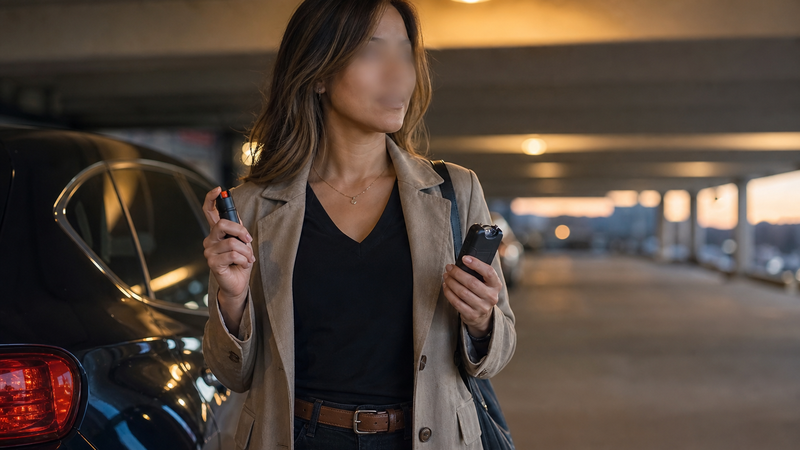
When I think about who carries pepper spray, I think about the woman walking her dog before sunrise. The college student cutting across a parking lot at 10 p.m. The mom who walks to her car alone after a late shift. For people in those situations, the ability to stop a threat before it closes the distance is a serious advantage. If you walk outside regularly, pepper spray designed for dog walkers is worth looking at — it’s built to be accessible and easy to deploy while your hands are occupied.
The honest limits of pepper spray: wind can affect the spray pattern outdoors. Some people — a small percentage — have a higher tolerance to capsaicin and may not be stopped immediately. And indoor use in a small space means you may also feel the effects. None of these are reasons to avoid it. They’re reasons to understand it. I always say: know your tools. That means knowing what they do and what they don’t.
Browse our full selection of pepper spray for sale to see the range of options — from keychain canisters to belt-carry models with safety clips built in.
What are the real differences between carrying a stun gun versus pepper spray day to day?
This is where the decision usually gets made — not on a spec sheet, but in real life. How do you actually carry this thing? Will you have it out or buried in a bag when you need it?
Stun guns come in a wide range of sizes and shapes. There are models that look like flashlights, models small enough to fit in a closed fist, and combination units that do both. The stun gun options we carry for hotel staff are a good example of how form factor matters for a specific environment and lifestyle — these are people who need something low-profile and accessible during long shifts in and around public spaces.
Pepper spray, on the other hand, is typically smaller and lighter. A canister on a keychain or in a pepper spray holster for your belt means you can get to it fast without digging through a purse. That matters when seconds count. Speed of access is part of what makes a tool effective — a stun gun at the bottom of a bag isn’t protecting anyone.
My honest advice: think about your daily routine. Where do you spend most of your time? Do you work indoors or outdoors? Do you drive or walk? Are you in a city or somewhere more rural? The answers to those questions will tell you more about which tool fits your life than any comparison chart will.
Can you carry both a stun gun and pepper spray at the same time?
Yes — and honestly, a lot of people do. There’s no rule that says you have to pick one. Many of the people I talk to carry pepper spray as their primary option and keep a stun gun as a backup, or vice versa. Having more than one tool isn’t overkill. It’s options.
What I’d caution against is carrying both and not being practiced with either. If you freeze trying to remember which one you grabbed, neither one helps you. Practice drawing whichever you carry. Know how the safety mechanism works. Know how to activate it under stress. That’s the part most people skip, and it’s the most important part of the whole conversation.
Preparation isn’t fear. I’ve believed that my whole adult life, and my time in the Army reinforced it every single day. Fear is what happens when you’re unprepared. Preparation is what gives you calm.
Who is a stun gun better for, and who is pepper spray a better fit for?
A stun gun may be a better fit if you work or spend time in indoor environments where a spray could affect others in the space. It’s also a strong option for someone who wants a tool that doesn’t expire — most stun gun batteries just need regular charging, while pepper spray canisters have a shelf life and need to be replaced. If you want something that doubles as a physical deterrent with a visible arc and an intimidating sound, a stun gun delivers that.
Pepper spray tends to be a better fit for outdoor use, for people who want distance between themselves and a threat, and for anyone who wants a lighter, smaller option that’s easy to keep on a keychain or belt. It’s also generally easier for beginners to feel confident with — there’s less hesitation around pressing a canister button than there can be around making physical contact with a stun gun.
If you’re newer to personal safety tools and you’re not sure where to start, our related post on how bad pepper spray actually hurts gives you an honest picture of what it does — that kind of understanding matters when you’re choosing what to carry.
Frequently Asked Questions About Stun Guns vs. Pepper Spray
Which is more effective — a stun gun or pepper spray?
Neither is universally more effective. Pepper spray works at a distance and affects the eyes and respiratory system immediately. Stun guns require direct contact and disrupt muscle control. Effectiveness depends on the situation, the user’s comfort level, and how quickly they can deploy the tool. The most effective option is always the one you’ll carry consistently and know how to use under stress.
Is pepper spray or a stun gun easier to use for a beginner?
Most beginners find pepper spray easier to start with. Pointing and pressing a button while keeping distance feels more intuitive than making contact with a stun gun. That said, both tools are straightforward once you’ve practiced. The key for any beginner is to train with whichever tool you choose — know how the safety works, how to draw it quickly, and how to activate it without looking down.
How close do you have to be to use a stun gun?
A standard contact stun gun must touch the person directly — typically within arm’s reach. Some stun guns are built into batons or flashlights to extend your reach slightly. This is the main limitation compared to pepper spray, which can reach six to fifteen feet depending on the formula and canister. If you rely on a contact stun gun, close-range distance is something you need to be prepared for.
Can pepper spray be used indoors?
Yes, but with caution. In a small enclosed space, the spray can affect anyone in the area — including you. Ventilation matters. Many people who work or live primarily indoors prefer a stun gun for this reason. If you do use pepper spray indoors, move to fresh air as quickly as possible after deployment. Know your environment and think through how your tool of choice performs in the spaces where you actually spend your time.
Does pepper spray expire?
Yes. Most pepper spray canisters have a shelf life of two to four years from the manufacture date, printed on the canister. As it ages, the pressure in the can decreases and the capsaicin can lose potency. Check the date when you buy and replace it before it expires. Stun guns don’t expire, but their batteries need to be charged regularly — check yours at least once a month.
Are stun guns legal everywhere in the United States?
No. Stun guns are legal in most states, but several states, cities, and municipalities have restrictions or outright bans. Pepper spray also has legal variations — some states limit canister size or concentration. Before you buy or carry either product, check the laws in your specific state and locality. This is not something to assume about. Laws change, and what’s legal in one city may not be in the next.
Can I carry both pepper spray and a stun gun at the same time?
In most places where both are legal, yes. Many people carry both and use one as a primary tool and one as a backup. If you do carry both, practice with each separately so you know exactly which one you’re reaching for in a stressful moment. Having two tools and not being practiced with either is not the same as being prepared. Train with what you carry.
What pepper spray brands does HerGuarded carry?
HerGuarded carries several trusted brands including Mace, Wildfire, Pepper Shot, and Streetwise, among others. Each brand has different formulas, canister sizes, and delivery patterns. Some are better for keychain carry, others for belt holsters or outdoor use. Browse our pepper spray selection to compare options by size, strength, and carry style — and reach out if you’re not sure which fits your situation best.
At the end of the day, this choice comes down to something simple: what will you actually have with you, and what will you actually be able to use? I’ve had this conversation hundreds of times with people who care about being safer — parents, students, professionals, people who’ve had a close call and decided they never want to feel that unprepared again. That feeling is what drove me to build HerGuarded in the first place.
You don’t need to carry both. You don’t need the most expensive option. You need the right tool for your life, carried consistently, and understood well enough to use it without thinking twice. Start there. Browse what we carry. And if you have questions, reach out — there’s a real person behind this store, and I’m glad to help you figure it out. Be aware. Be prepared. Be confident.