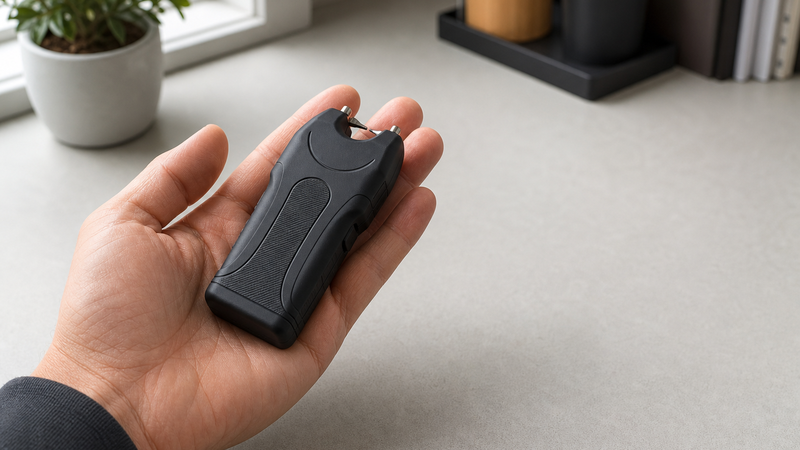
Most stun guns sell somewhere between $15 and $100, with the majority of reliable options landing in the $25–$65 range. But price alone tells you almost nothing useful. A $20 stun gun and a $60 stun gun can look nearly identical — the difference shows up in voltage, build quality, battery life, and whether the thing actually works under real conditions.
Here’s the angle most people miss when they start shopping: the question isn’t really “how much does a stun gun cost?” The better question is “what am I actually buying at each price point — and what am I giving up?” That reframe changes everything. I’ve watched people spend $15 on something they’ll never carry because it feels cheap and flimsy, and I’ve watched people spend $80 on features they don’t need. Neither is smart shopping. Let’s break this down the right way.
What does a stun gun actually do, and why does that affect the price?
A stun gun delivers a high-voltage, low-amperage electrical charge on contact. That charge disrupts the body’s neuromuscular system — it causes involuntary muscle contractions, disorientation, and temporary loss of muscle control. The goal is to give you enough time to get away from a threat. It is not designed to cause permanent injury.
The components inside the device — the transformer, the capacitors, the battery system, the probes — vary significantly in quality across price points. A cheaper device may use lower-grade capacitors that drain faster, deliver an inconsistent charge, or fail earlier in its lifespan. A better-built device holds its charge longer, delivers reliably, and is constructed to survive being dropped in a parking lot.
Voltage is what gets advertised most heavily, and it’s also the most misunderstood spec. You’ll see numbers like 50 million volts, 80 million volts, even claims of 100 million volt stun guns. Those numbers refer to the peak open-air voltage — the arc you see when you test-fire it. What matters for effectiveness is amperage and how the charge is delivered through clothing and on contact. A well-engineered lower-voltage device can outperform a poorly built “higher voltage” one. Don’t let the big number be the only thing you’re buying.
What do you get at each stun gun price range?
Think of stun gun pricing in three tiers. Each tier represents a different level of commitment — to quality, to features, and to how seriously you’re taking the tool.
Under $25: Entry-level devices. Basic stun gun function, minimal extra features. Some of these are perfectly adequate for someone who wants a simple backup option. Others are cheaply made and won’t hold up. At this price, the build quality is the wildcard. If you go this route, stick to brands you can verify. The risk isn’t just that it breaks — it’s that it fails when you’re counting on it.
$25–$65: This is where most of the practical, well-built options live. You’ll find devices with rechargeable batteries (no disposables to forget to replace), built-in safety switches, rubberized grips, solid amperage, and added features like a built-in LED flashlight or a wrist strap disable pin. Brands like Streetwise, Runt, BashLite, and Mace operate in this space. These are the options I point most people toward — good balance of performance, durability, and price.
$65–$100+: Higher-end devices and specialized form factors. This tier includes combination tools — a stun gun built into a tactical flashlight like the Strikelight 2, multi-function devices, higher-amperage units, or devices designed for a specific use case. If you’re looking at stun guns for home defense where size and raw stopping power matter more than concealability, this tier is worth considering. You’re paying for engineering, not just marketing.
Does form factor change the price — and should it?
Yes, and often for good reason. A stun gun that’s been engineered into a specific shape for a specific use case costs more than a plain rectangular box. But that cost can be entirely worth it depending on how you live.
Someone who walks their dog before sunrise needs something different from someone who commutes through a parking garage. A stun gun for walking the dog at night might pair better in a design that fits in a jacket pocket or clips to a leash handle. A runner needs something that stays put during movement — check out options built specifically as stun guns for runners if that’s your situation. A design that works perfectly for one lifestyle is awkward in another.
The Runt, for example, is a compact device with a grip design that keeps it from being knocked out of your hand. That engineering decision — that shape — matters in a moment of stress. The MultiGuard combines a stun gun, alarm, and flashlight in one unit. The ZAP line offers walking sticks and canes with stun gun capability built in. The Stun Bat is built for home use where reach and impact matter. These specialized designs cost more because they solve a specific problem well. If that problem is yours, the price difference is justified.
What features actually add value — and which ones are just marketing?
This is where smart shopping separates itself from impulse buying. Some features genuinely make a stun gun more effective and safer to carry. Others are noise.
Features worth paying for:
- Rechargeable built-in battery — removes the risk of dead disposable batteries when you need it
- Safety switch or slide — prevents accidental discharge in a bag or pocket
- Wrist strap with disable pin — if the device is grabbed away from you, it deactivates
- Rubberized grip — reduces the chance of dropping it under stress
- Built-in LED flashlight — useful at night and in low-light environments without being a gimmick
- Solid amperage rating — look for this alongside voltage; it tells you more about actual delivery
Features that are mostly marketing:
- Astronomical voltage claims with no amperage context — peak voltage numbers without delivery specs are largely meaningless
- Tactical aesthetics that add bulk without adding function
- Accessories bundled in that you’ll never use
The best stun gun is the one that fits your hand, fits your routine, and you’ll actually carry every day. A $65 device you leave at home because it’s too bulky is worth exactly zero dollars in a moment you need it.
Are cheap stun guns actually dangerous to buy?
Sometimes. Not always — but the risk is real enough to take seriously. The problem with very low-cost devices isn’t usually that they’ll hurt you (though poor wiring in any electrical device carries some risk). The bigger problem is reliability. A device that fires inconsistently, or doesn’t fire at all when you need it, creates a false sense of security that’s arguably worse than carrying nothing.
I’ve also seen very cheap devices with poor safety mechanisms — where the safety switch is so loose that the device can discharge inside a bag. That’s a problem. Stick to recognizable brands even at lower price points. On this site, we carry brands we’ve vetted — Streetwise, Runt, BashLite, Mace, TASER, and others — because the product has to actually work. That’s non-negotiable for me.
If you’re looking at a stun gun from a brand you’ve never heard of on a random marketplace listing, ask yourself: who stands behind this if it doesn’t work? With a known brand sold through a real retailer, that answer is clear.
Should you spend more on a TASER versus a traditional stun gun?
This comes up a lot, and it’s worth addressing directly because TASER devices sit at a higher price point — often $150 to $200 or more for consumer models. A TASER is not a stun gun in the traditional sense. A stun gun requires direct contact with the target. A TASER fires probes on a wire up to 15 feet, delivering the charge at a distance. That’s a fundamentally different capability.
If standoff distance matters to you — if the idea of having to be right next to someone to use your device concerns you — a TASER is worth the higher price. If you want a contact deterrent that’s affordable, reliable, and easy to carry daily, a quality stun gun in the $30–$60 range from a solid brand does the job. The right answer depends on your situation, not on which number looks more impressive.
For most people — someone walking to their car, someone on a morning walk, a college student navigating campus — a well-built contact stun gun is practical, legal in most states, and genuinely effective. Always check your state and local laws before purchasing or carrying any stun device. Laws vary significantly by location.
Frequently Asked Questions About Stun Gun Prices
What is the average price of a good stun gun?
A reliable, well-built stun gun typically costs between $25 and $65. Devices in this range generally include rechargeable batteries, safety switches, solid amperage, and durable construction. You can find usable options below $25, but build quality becomes inconsistent. Above $65, you’re typically paying for specialized form factors, combination tools, or higher-end features like extended range or higher amperage output.
Is a more expensive stun gun more effective?
Not automatically. Price reflects build quality, features, and engineering — not always raw effectiveness. A $50 stun gun from a reputable brand with solid amperage and a reliable discharge mechanism can outperform a poorly engineered $90 device. Focus on amperage alongside voltage, look at the safety features, and consider how the form factor fits your actual daily carry routine. Brand reputation matters more than price alone.
Why do some stun guns claim 100 million volts but cost under $30?
Those voltage numbers refer to peak open-air arc voltage, not the charge delivered on contact. High voltage claims with no amperage context are largely a marketing convention in this industry. An inexpensive device can generate a visually impressive spark while still having poor delivery, inconsistent firing, and a short lifespan. Amperage and build quality are better indicators of real-world effectiveness than voltage numbers alone.
Do I need to spend a lot on a stun gun for everyday carry?
No. For most everyday carry situations — walking alone, commuting, parking garages, campus — a solid stun gun in the $30–$50 range from a reputable brand covers your needs. The most important factor isn’t cost; it’s whether you’ll actually carry it. A quality compact device that fits your routine beats an expensive one sitting in a drawer at home. Size, weight, and ease of access matter more than price.
How long does a stun gun last, and does that affect the value?
A well-built stun gun with a rechargeable battery can last several years with normal use. Cheaper devices with lower-quality components — capacitors, battery cells, wiring — tend to degrade faster and may become unreliable within a year or two. When you factor in lifespan, a $50 device that works reliably for five years is a better value than a $20 device you replace every year and a half. Rechargeable batteries also eliminate the hidden cost of disposables.
Are stun guns legal to buy in every state?
No. Stun gun laws vary significantly by state and sometimes by city or county. Most U.S. states permit civilian ownership of stun guns, but some have restrictions on voltage, carry method, or who can purchase. A few jurisdictions restrict or prohibit them entirely. Always check the laws in your state and local area before purchasing or carrying a stun gun. This is your responsibility as the buyer, and it changes depending on where you live.
What is the difference between a stun gun and a TASER in terms of price?
Consumer TASER devices typically run $150–$200 or more, while quality stun guns are available in the $25–$65 range. The price difference reflects a real functional difference: a TASER fires probes at a distance (up to 15 feet on some models), while a stun gun requires direct contact. If standoff distance is important to your safety plan, a TASER’s higher price may be justified. For close-range deterrence and daily carry, a stun gun is practical and significantly more affordable.
What stun gun features should I prioritize at a mid-range budget?
At a $30–$60 budget, prioritize a rechargeable built-in battery, a reliable safety switch, a rubberized grip, and a wrist strap with a disable pin if possible. A built-in LED flashlight adds real utility for low-light situations. Skip devices that lead with only voltage numbers and provide no amperage information. Look for brands with an established reputation — Streetwise, Runt, Mace, and BashLite are solid examples in this price range.
The real innovation in how you shop for a stun gun isn’t finding the lowest price or the highest voltage number — it’s asking better questions before you buy. What does my daily routine actually look like? Where do I feel least safe? What will I actually carry consistently? Answer those first, then match the tool to the life. That’s how you turn a $40 purchase into something genuinely useful instead of something that sits in a junk drawer.
Browse the stun gun options for walkers if you’re looking for something that fits an active outdoor routine, or take a look through the full selection at HerGuarded and filter by the features that match your situation. If you have questions, reach out — I’d rather spend five minutes helping you find the right tool than have you guess and end up with the wrong one.