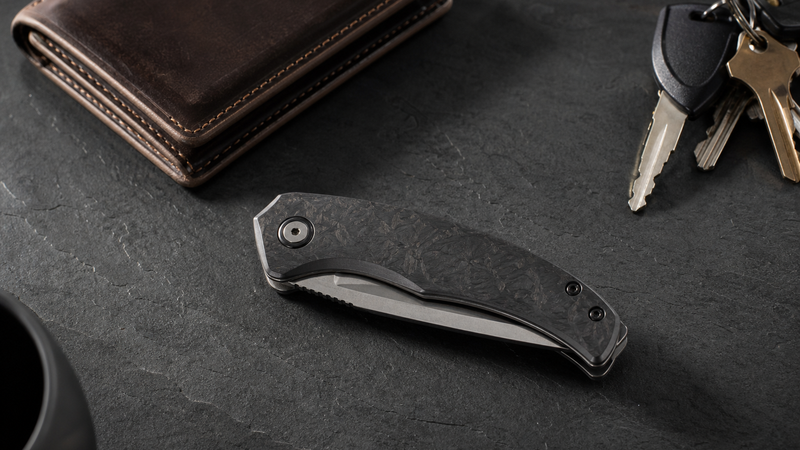
A self-defense knife worth carrying has five things working in its favor: a blade length that falls within your state’s legal limit, a locking mechanism that won’t close on your hand under pressure, a handle with enough texture to hold even when your grip is less than perfect, one-hand deployment, and a size you’ll realistically carry every day. If any one of those five fails, the knife fails.
Most people who shop for a self-defense knife start in the wrong place. They focus on how the blade looks — the steel finish, the color of the handle, whether it looks tough enough. Those things are secondary. A blade that photographs well but deploys slowly or sits in a pocket you never reach for isn’t a safety tool. It’s a novelty. At HerGuarded, I want you to buy the knife you’ll actually have with you, not the one that looked impressive in a product photo. Let’s talk about what actually matters.
What blade length is right for a self-defense knife you carry daily?
Start here, and start with your state law — not your preference. Blade length restrictions vary significantly across the country. Some states limit legal carry to blades under three inches. Others allow four. A handful have no restriction at all, and a few make certain blade styles illegal regardless of length. Before anything else, look up your local laws. I can’t give you legal advice, and I won’t pretend to. What I can tell you is that carrying a blade longer than the law allows doesn’t make you safer — it makes you vulnerable to charges that have nothing to do with self-defense.
Within legal limits, a blade between 2.5 and 3.5 inches is the range most serious everyday carry practitioners settle on. It’s enough edge to be functional, it fits standard pocket clips and sheaths without announcing itself, and it falls within the legal threshold of most jurisdictions. Longer isn’t automatically better. Precision and deployment speed matter more than blade length in a close-quarters situation. A modest blade you can open in under a second with one hand is a better tool than a longer one that requires two hands and a second to think about it.
What locking mechanism should a quality self-defense knife have?
This is the one feature people most often overlook, and it’s the one that matters most for safety — not the attacker’s safety, yours. A folding knife that closes on your fingers under pressure is a liability. The lock is what prevents that.
Liner locks and frame locks are the two most common mechanisms in quality folding knives, and both are reliable when manufactured to a high standard. A liner lock uses a thin strip of steel that springs behind the blade when it opens, preventing the blade from folding back. A frame lock works the same way but uses part of the handle itself — which makes it generally more robust because there’s more material holding the blade open. For a self-defense application, a frame lock is the stronger choice if you have the option.
Lockback designs — where a spine-mounted rocker holds the blade open — are also reliable, but they typically require two hands to close, which slows you down less in an emergency than you might think. What you want to avoid are knives with friction-only mechanisms or cheap liner locks that flex out of position with lateral pressure. Test the lock before you trust it. With the blade open, apply sideways pressure against the spine and then against the flat. A quality lock won’t give.
What handle material and grip texture matter for a self-defense knife?
A self-defense situation is, by definition, a high-stress moment. Your hands may be shaking. You may be sweating. Your grip matters more under those conditions than under controlled range or practice conditions, which means handle material isn’t an aesthetic decision — it’s a performance decision.
G-10 fiberglass composite is the benchmark handle material for serious carry knives. It’s lightweight, extremely durable, impervious to moisture and temperature, and can be textured aggressively enough to hold under almost any conditions. Aluminum handles are common in mid-tier knives — they look clean and feel solid, but they can become slick when wet. Wood and bone are beautiful materials that have no business on a working self-defense knife. They swell, crack, and lose texture over time.
Handle texture is as important as material. A smooth handle on a damp hand is a problem. Look for jimping — small notched ridges — on the spine near the thumb rest, and textured scales on the grip panels. The choil, the small finger groove just ahead of the handle, gives your index finger a hard stop and keeps your hand from riding up onto the blade. Small details. Meaningful differences.
How fast should a self-defense knife deploy, and what features make it faster?
In any close-quarters threat, you do not have time to fiddle with a deployment mechanism. One hand. One motion. The knife needs to be open before your brain finishes forming the thought. That is the standard a self-defense knife should meet.
Assisted-opening knives use a spring mechanism that completes the deployment once you push or pull a small thumb stud or flipper tab past the halfway point. You start the motion; the spring finishes it. These are generally legal in more jurisdictions than automatic (switchblade) knives, and they deploy nearly as fast for practical purposes. A flipper tab — a small protrusion on the blade spine that acts as your purchase point — is often easier to engage consistently than a thumb stud, especially under pressure, because you can use it with either hand.
Practice matters here. Whatever deployment mechanism your knife uses, practice it until it is muscle memory. Draw from your carry position, deploy, and close — repeatedly, until it stops requiring conscious thought. A knife you’ve practiced with is a different tool than the same knife you’ve only handled twice. This isn’t military training doctrine; it’s basic preparation. Know your tool.
What carry position and clip design should a self-defense knife have?
Where you carry the knife determines how fast you can access it when it matters. A knife buried in a bag is functionally useless as a self-defense tool. The best carry knives clip to the edge of a front pocket with the handle sitting just above the pocket line, accessible with a single reach of the strong hand. Some people prefer a deep-carry clip that keeps the knife nearly invisible — that’s a reasonable choice for discretion, but verify that you can draw it cleanly every time before you depend on it.
A reversible clip — one that can mount tip-up or tip-down, and switch from right to left — is a mark of a thoughtfully designed knife. It means the tool was built for real people who carry differently. Tip-up carry puts the edge positioned for a natural draw-and-deploy motion. Tip-down carry can feel more comfortable for some people. Try both and see what gives you the cleanest, fastest draw from your natural carry position. Then practice that draw until it’s automatic.
One more thing on carry: if you won’t carry it because it’s too heavy, too bulky, or too awkward in the pocket, it won’t be there when you need it. A moderately capable knife you have with you at all times is worth more than an exceptional knife in your dresser drawer. This is the same principle I apply to every product at HerGuarded, from non-lethal self-defense options to everyday carry tools. The best tool is the one that’s actually on your person.
How does a self-defense knife fit into a broader personal safety plan?
A knife is one option. It is not a complete strategy. I say this as someone who has thought seriously about personal safety for a long time — a single tool, no matter how well chosen, doesn’t substitute for awareness, preparation, and layered options.
For most people, a self-defense knife works best as part of a broader everyday carry setup that might include a high-decibel personal alarm for immediate deterrence, a quality pepper spray for distance and non-contact response, and a knife as a last-resort close-quarters option. Each tool fills a different gap. Pepper spray works at arm’s length or beyond. A personal alarm creates noise and draws attention. A knife is a physical deterrent and last resort. None of these are substitutes for situational awareness — that comes first, every time.
At HerGuarded, I carry what I sell, and I recommend what I’d put in my own family’s hands. If you’re building out your personal safety kit, take a look at the full range of tools available — from proven defensive sprays to personal alarms — so you’re covered at every range, not just one.
Frequently Asked Questions About Choosing a Self-Defense Knife
Is a folding knife or a fixed-blade knife better for self-defense?
For everyday concealed carry, a folding knife is the practical choice. It’s compact, clips to a pocket, and is legal in far more places than a fixed blade. A fixed blade has no deployment step and is structurally stronger, but carrying one concealed is restricted or illegal in many jurisdictions. Most everyday carry self-defense situations call for the accessibility of a folder over the structural advantage of a fixed blade.
What is the safest blade edge for a self-defense knife — plain or serrated?
A plain edge is more versatile and easier to maintain to a consistent sharpness, which matters in a defensive context. Serrations cut through webbing, rope, or seat belts effectively, but they’re harder to sharpen and can snag in unexpected ways under pressure. Many serious everyday carry practitioners choose a plain edge or a knife with partial serration near the handle — giving you both options without committing fully to either.
How do I know if a self-defense knife is legal in my state?
Laws vary by state, county, and sometimes city. Restrictions may cover blade length, blade style (automatic, gravity, or switchblade), concealed vs. open carry, and location restrictions like schools or government buildings. Always check your specific state statute and local ordinances before purchasing or carrying any knife. This post is not legal advice — consult a local attorney or your state’s official code if you need a definitive answer for your jurisdiction.
How often should I sharpen a self-defense knife?
A self-defense knife should be sharp enough to shave arm hair — that’s the practical test. If it can’t do that, it needs sharpening. How often depends on how much you use it. If you use the knife daily for tasks, check the edge weekly. If it’s dedicated carry only, inspect it monthly. A dull knife requires more force and is less predictable under pressure. Sharpness isn’t a luxury — it’s part of the tool’s function.
What’s the difference between an assisted-opening and an automatic knife?
An assisted-opening knife requires you to initiate deployment by pressing a thumb stud or flipper tab — a spring mechanism then completes the opening. An automatic knife (switchblade) opens with a button press alone, requiring no blade contact to initiate. Assisted-opening knives are legal in most U.S. states. Automatics are restricted or banned in many jurisdictions. Both deploy quickly in practical use; verify your local law before choosing.
Should a self-defense knife have a finger guard or choil?
Yes — both serve important safety functions for the carrier. A finger guard prevents your hand from sliding forward onto the blade under thrust. A choil — a curved notch just ahead of the handle — gives your index finger a positive stop and improves control. On a self-defense knife, where grip conditions may be far from ideal, these features prevent injuries to your own hand. They’re small design details that separate a thoughtfully built carry knife from a cheap lookalike.
Can I carry a self-defense knife and pepper spray together?
Yes, and it’s actually a smarter setup than relying on either alone. Pepper spray gives you a stand-off option — effective at several feet without physical contact. A knife is a last-resort close-quarters tool. Pairing them means you have a response for more situations. Carry them in positions where you can reach each one cleanly without confusion under stress. Know which tool you’re reaching for before you reach for it — that decision shouldn’t happen in the moment.
What should I practice with a self-defense knife?
Focus on three things: draw from your carry position, one-hand deployment, and re-closing safely. You don’t need martial arts training to use a knife defensibly — you need to be able to get it open, in your hand, without fumbling, when stress is high and your fine motor skills are compromised. Practice the draw-and-deploy cycle slowly and deliberately until it becomes automatic. Practice with the actual knife you carry, not a substitute, so the feel and weight are familiar.