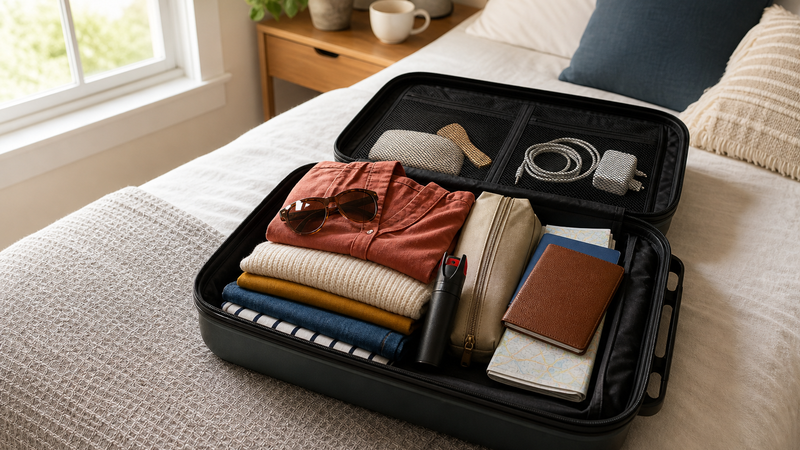
No, you cannot bring pepper spray in your carry-on bag on a plane. The TSA prohibits pepper spray in the cabin entirely. However, you can pack one canister of pepper spray in your checked luggage — with conditions: it must be 4 fluid ounces or less and have a safety mechanism to prevent accidental discharge. If you travel without knowing this distinction, you either lose your spray at the checkpoint or miss a legal option to travel armed.
Most people assume the answer is a flat no and leave it there. That assumption costs them. The reality is more interesting — and more useful — than a simple prohibition. TSA rules, airline policies, and destination laws all play a role, and the traveler who understands all three arrives prepared instead of frustrated. Let me walk you through how this actually works.
Why does the TSA allow pepper spray in checked bags but not carry-ons?
The logic here surprises most people, but it makes sense once you understand what the TSA is actually worried about. In the cabin of a pressurized aircraft, an accidentally discharged canister of OC spray becomes a confined-space emergency. There is nowhere for the irritant to go. At altitude, with recycled air and no exit, even a small accidental discharge could affect the entire cabin — crew and passengers alike. That is the real concern, and it is a legitimate one.
In the cargo hold, though, the risk profile is completely different. The hold is separated from passengers, ventilated differently, and not a confined human environment during flight. That is why the TSA draws the line there. One canister, 4 ounces or less, safety mechanism engaged. Those are the conditions. Meet them and you can legally check your pepper spray.
This is not a loophole or a gray area. It is written TSA policy. The relevant rule sits under the “prohibited items” guidance with a specific carve-out for checked baggage. Before you pack, verify the current rule at the TSA website — policies can update, and I am not a lawyer or a federal agency. Confirm before you fly.
What counts as a “safety mechanism” under TSA rules?
This is where the detail matters more than most travelers realize. A safety mechanism, under TSA language, means the canister must be designed and equipped to prevent accidental discharge during transport. That is not just a cap you snap on — it is a built-in safety feature on the canister itself, something that physically prevents the trigger from being pressed accidentally.
Most quality defensive sprays sold today include this. A flip-top safety tab, a locking clip, a rotating safety — these are standard features on well-made canisters. Cheap, older, or novelty sprays sometimes lack them. If you are packing a canister for travel, check it before you leave the house. Press the safety mechanism into place, confirm it locks, and pack the canister in a way that reduces pressure on the nozzle — ideally in a small protective case or tucked securely in clothing so it cannot roll around freely in your bag.
If you want to see what a properly built defensive spray looks like before you fly, browse our pepper spray selection at HerGuarded. Every canister we carry is designed with practical use in mind, which includes safety features that matter in real-world situations — including travel.
Does the size limit — 4 fluid ounces — matter in practice?
Yes, and here is where it gets interesting for serious buyers. Most everyday carry pepper sprays are well under 4 ounces. The compact canisters designed for purses, pockets, or belt holsters typically run between 0.5 and 2 ounces. Those fit the TSA rule comfortably.
The sprays that push or exceed the 4-ounce limit are the high-volume defensive and tactical units — the kind of maximum strength pepper spray some buyers prefer for home defense or high-risk environments. If that is what you own, check the fluid volume on the label before you pack it. At exactly 4 ounces, you are at the limit. Over 4 ounces, it cannot go in checked luggage either. Leave those at home or purchase a travel-appropriate size for your trip.
Bear spray falls into a completely separate category — those canisters are large-volume by design and are banned from both carry-on and checked bags. If you have ever wondered about the distinction, I covered it in detail in this post on flying with bear spray. Short version: bear spray does not make the cut under any TSA exception.
What do individual airlines say about pepper spray in checked luggage?
This is the part most travelers miss, and it flips the whole conversation. TSA rules set a federal floor for what is and is not allowed through security. But airlines are private carriers, and they have the authority to impose stricter policies than the TSA requires. Some do.
A small number of carriers have policies that prohibit pepper spray in checked baggage entirely, regardless of what the TSA allows. Others follow the TSA standard directly. A few have specific packaging requirements beyond the basic safety mechanism rule.
The practical move: before you fly, look up your specific airline’s dangerous goods or prohibited items policy — not just the TSA page. They are often listed under “hazardous materials” in the airline’s baggage information section. If the policy page is unclear, call the airline directly and ask. Get a name and a confirmation number if you can. I know that sounds like extra work, but losing a canister at check-in is not how anyone wants to start a trip.
What happens to pepper spray that isn’t allowed through?
If a TSA officer or airline agent determines your canister cannot fly — wrong size, no safety mechanism, carry-on bag, or an airline with a stricter policy — the canister is confiscated. It does not get held for you. It does not get mailed home. It is gone.
That is not a reason to avoid traveling with pepper spray. It is a reason to know the rules before you get to the checkpoint, not after. Pack smart, confirm your airline’s policy, meet the size and safety requirements, and put it in checked luggage only. Do all of that and you have done everything right.
One more thing to think about: your destination. Traveling within the U.S., most states allow civilians to possess and carry pepper spray with some variations in age requirements and formula restrictions. Traveling internationally is a completely different situation. Many countries prohibit pepper spray outright — it is classified as a weapon in some jurisdictions, and penalties for possession can be severe. If you are leaving the country, research the laws of your destination before you pack. This is not an area where it is safe to assume.
Is pepper spray worth traveling with, or should you just buy it at your destination?
Here is a question worth asking honestly: is it better to navigate the TSA rules, pack carefully, and carry your own canister — or just buy one when you arrive?
For domestic travel, the case for traveling with your own spray is simple. You know the canister. You know how it works, where the safety is, how it fits your hand. Switching to an unfamiliar product in an unfamiliar place is not ideal. Familiarity with your own gear matters — in the Army, we did not hand soldiers unfamiliar equipment and wish them luck. You train on what you carry. That logic applies here too.
For international travel, buying at your destination is often the only legal option — and even then, many countries do not allow civilian purchase or possession at all. Plan accordingly.
If you are building a travel kit and want a canister that is specifically sized for portability and easy carry, a compact design paired with a pepper spray holster for belt keeps it accessible without being bulky. Accessible matters. A canister buried in a bag is not much of a tool when you actually need it.
And if you are someone who carries every day — not just when traveling — a police-grade pepper spray is worth understanding. These are formulated for serious civilian defense, not novelty. Know what you carry and why you carry it. That is the standard I hold myself to, and it is the standard I recommend to every customer.
Frequently Asked Questions About Bringing Pepper Spray on a Plane
Can I put pepper spray in my carry-on bag?
No. The TSA prohibits pepper spray in carry-on bags entirely. If a canister is found during screening, it will be confiscated and will not be returned. Your only legal option for bringing pepper spray on a flight is to pack it in your checked luggage, meeting the TSA’s size and safety mechanism requirements.
How much pepper spray can I bring in my checked bag?
TSA rules allow one canister of up to 4 fluid ounces in checked luggage. The canister must have a safety mechanism designed to prevent accidental discharge. Anything over 4 fluid ounces is prohibited from both carry-on and checked bags. Most standard everyday carry sprays are well within this limit.
Does my airline have to follow the TSA pepper spray rule?
No. The TSA rule is a federal minimum, but individual airlines can set stricter policies. Some airlines prohibit pepper spray in checked luggage regardless of TSA allowances. Always check your specific airline’s dangerous goods or hazardous materials policy before you fly — and call if the website is unclear.
Can I bring pepper spray on an international flight?
This depends on both your airline and your destination country. Many international carriers prohibit pepper spray in checked bags. More importantly, many countries classify pepper spray as a prohibited weapon, and bringing it through customs can result in confiscation, fines, or worse. Always research the laws of your destination before packing pepper spray for international travel.
What happens if TSA finds pepper spray in my carry-on?
The canister will be confiscated at the checkpoint. TSA officers do not hold items for pickup, and they are not returned after a flight. If you arrive at the checkpoint with pepper spray in your carry-on, you can sometimes ask to return to check-in and transfer it to checked luggage — but that depends on time, the checkpoint, and airline policy.
Is pepper spray legal to carry in all U.S. states?
Pepper spray is legal in all 50 states for civilian use, but laws vary on age requirements, formula strength, and canister size. Some states have specific restrictions. Before buying or carrying, check your state and local laws. I am not a lawyer and this is not legal advice — confirm with your state’s statutes or a legal professional.
What is the difference between traveling with pepper spray and bear spray?
Bear spray canisters are large-volume aerosols designed for a completely different threat at much greater range. The TSA treats them differently — bear spray is prohibited from both carry-on and checked luggage on commercial flights, regardless of size. Standard defensive pepper spray in a 4-ounce or smaller canister with a safety mechanism is the only OC product with a checked-bag exception.
Should I buy a new canister of pepper spray at my destination instead of flying with one?
For domestic U.S. travel, traveling with your own canister is usually the better choice — you know the product, the safety mechanism, and how it handles. For international travel, buying at your destination may be your only legal option, though many countries restrict civilian possession entirely. Research your destination’s laws before you decide either way.