Bear spray can work on mountain lions. The capsaicin-based formula that stops bears also affects a mountain lion’s eyes, nose, and respiratory system, making it a reasonable deterrent in a close encounter. That said, it is not a guaranteed solution — range, timing, wind, and your own readiness all determine whether it works when you need it most.
If you hike, camp, or spend time in lion country, this is a question worth taking seriously. I’m Juan Foster, owner of HerGuarded, and I want to give you a straight answer — not a sales pitch. You deserve to know what bear spray actually does, what its limits are, and how to carry it so it’s useful instead of just something sitting in your pack.
What is bear spray, and how does it affect large predators like mountain lions?
Bear spray is a pressurized aerosol canister filled with capsaicin and related capsaicinoids — the same compounds that make hot peppers burn. It’s formulated at a higher concentration than most personal defense sprays, typically between 1% and 2% major capsaicinoids, and it’s designed to create a wide cloud at a distance rather than a targeted stream.
When a large animal — bear, mountain lion, or otherwise — encounters that cloud, it hits the eyes, mucous membranes, and upper respiratory tract. The effect is immediate irritation, temporary vision impairment, and respiratory discomfort. The animal’s instinct, most of the time, is to stop advancing and retreat. That’s the goal. Not injury — deterrence.
Mountain lions share enough mammalian biology with bears that the chemistry works on them too. There’s no reason from a physiological standpoint that it wouldn’t. The same nerve receptors that make capsaicin painful for a grizzly are present in a cougar. Wildlife biologists and park rangers who operate in lion country generally acknowledge bear spray as a credible non-lethal tool to have on hand.
What bear spray is not: it is not a force field, it is not a guarantee, and it does not work through packaging. A canister on the bottom of your pack does nothing. The only bear spray that matters is the bear spray you can reach and deploy in under three seconds.
How does mountain lion behavior affect whether bear spray will work?
This is where I want to be honest with you, because mountain lion encounters are different from bear encounters in one important way. Bears often give you warning. They huff, bluff charge, and posture before committing. Mountain lions are ambush predators. When they attack, they typically do it fast, from behind, and at close range.
Bear spray is most effective when you have a few seconds — enough time to see the threat coming, draw the canister, remove the safety clip, and discharge into the animal’s face. In a bluff charge or a slow stalk, that window exists. In a surprise attack from behind, it may not.
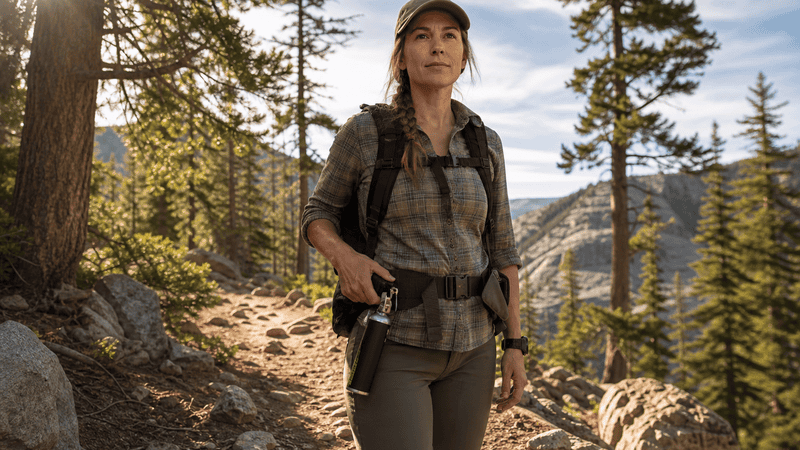
This doesn’t mean you shouldn’t carry it. It means you should carry it on your body — on a chest holster, a hip holster, or clipped to a pack strap where your hand can reach it fast. And it means bear spray is one layer of your safety plan, not the whole plan. Awareness comes first. When you’re in mountain lion territory, you want to be watching your surroundings, making noise, hiking in groups when possible, and keeping children and pets close.
The spray is for the moment when awareness didn’t give you enough warning. Have it ready, know how it works, and give yourself the best chance you can. That’s all any of us can do.
What’s the effective range of bear spray against a charging mountain lion?
Most bear spray canisters have an effective range of 20 to 35 feet. That range matters more than you might think. Mountain lions can cover a lot of ground in a short burst of speed. You want to deploy the spray before the animal closes to within arm’s reach — not as a last-second reaction but as a deterrent that stops the charge.
If a lion is stalking you and you spot it at a distance, you’re in a much better position than if it’s already in motion. Start making noise, make yourself look large, back away slowly, and if it continues to approach or charges, deploy the spray in a sweeping pattern at the animal’s face level when it enters the 30-foot range.
Wind is a real factor. A headwind can push the cloud back at you. A crosswind can reduce its effectiveness. Be aware of wind direction before you ever need to use it — not in the moment of a charge. This is the kind of thing you think through before you’re on the trail, not during. Preparation before the moment is what makes the moment manageable.
For hikers spending serious time in remote areas, I’d recommend looking at our pepper spray for hiking and camping options, which are selected with outdoor use and accessibility in mind.
Is bear spray better than regular pepper spray for mountain lion defense?
For use against large predators at distance, yes — bear spray has meaningful advantages over standard personal defense spray. The range is the biggest factor. Most pepper sprays designed for personal defense have a range of 10 to 15 feet and deliver a targeted stream or short burst. That’s appropriate for a human threat at close range. It is not ideal for stopping a charging 130-pound animal at 25 feet.
Bear spray also delivers a larger volume of capsaicin in a wider cloud, which is better suited to hitting a fast-moving animal than a precision stream aimed at a moving target. The cloud doesn’t require perfect aim. That matters when your hands may not be steady.
That said, if you’re hiking where mountain lions are possible but you’re also concerned about two-legged threats — a parking lot, a trailhead, a campground — a police-grade pepper spray for civilians gives you something more concealable and easier to carry on your person all day. It’s worth thinking about what threats are most realistic for where you’re going and matching your tool to that situation.
Some hikers carry both. That’s not overkill — that’s thinking ahead. One tool for the trail, one for the trailhead. Be prepared.
How should you carry bear spray so it’s actually useful in an emergency?
This is the part most people skip, and it’s the part that matters most. A bear spray canister that takes you 20 seconds to find and deploy is almost no bear spray at all. Speed of access is everything.
Here’s what actually works:
- Chest holster: Clip the canister to a chest strap or dedicated chest holster on your pack. Your hand reaches it without twisting or digging.
- Hip holster: A dedicated bear spray hip holster keeps the canister at your side where you can draw it like you would a water bottle — instinctively.
- Pack strap clip: Some canisters come with a belt or strap clip. Use it on the shoulder strap of your pack, not buried inside it.
Practice the draw before you need it. Remove the safety clip with your thumb and hold the canister at about 45 degrees. When you deploy, sweep the cloud in front of the advancing animal rather than trying to aim at its eyes directly. You want a wall of spray, not a precision shot.
Check the expiration date before every trip. Capsaicin degrades over time, and a canister that’s past its date may not have the pressure or potency you’re counting on. Check the safety clip too — it should be secure enough to prevent accidental discharge but loose enough to remove with one hand quickly.
If you’re older or have limited grip strength, this is worth factoring into your gear selection. We have options worth looking at on our pepper spray for elderly defense page that address ease of use — the same principle applies here.
What else should hikers do to stay safe in mountain lion territory?
Bear spray is a tool. Awareness is a habit. Both matter.
Mountain lions are most active at dawn and dusk. Hiking during midday reduces your risk. They prefer to hunt alone and are more cautious around groups — hike with others when you can. If you’re hiking with children, keep them between adults and never let them run ahead or lag behind. A child moving quickly and independently looks like prey to an ambush predator.
If you encounter a mountain lion:
- Do not run. Running triggers pursuit instinct.
- Face the animal. Maintain eye contact.
- Make yourself look larger — raise your arms, open your jacket.
- Speak in a firm, loud voice. Do not crouch or crouch down.
- Back away slowly without turning your back.
- If it attacks, fight back. Use every tool available — your spray, your trekking poles, your hands. Do not play dead with a mountain lion.
Know the terrain before you go. Check with local rangers about recent lion activity in the area. Trail signs often post warnings when lions have been spotted. Take those seriously.
Preparation isn’t fear. It’s responsibility — to yourself and the people hiking with you.
Frequently Asked Questions About Bear Spray and Mountain Lion Defense
Has bear spray actually been used to stop a mountain lion attack?
Documented cases specifically involving mountain lions and bear spray are rare compared to bear encounters, partly because mountain lion attacks on humans are less common overall. However, wildlife professionals in lion country carry it as a standard tool, and the physiological basis for its effectiveness against large felines is sound. It is a reasonable deterrent, not a proven guarantee.
Can I carry bear spray on a plane or in a car?
Bear spray is not permitted in aircraft cabins or checked baggage under TSA and FAA regulations due to its pressurized contents. In a vehicle, store it in a cool location — not in a hot trunk or glove compartment — and make sure it’s secured so it can’t roll, discharge accidentally, or become a projectile in a crash. Check your state laws before transporting any aerosol defensive spray. For vehicle-specific options, see our pepper spray for car page.
What concentration of capsaicin should bear spray have?
The EPA registers bear spray at a minimum of 1% major capsaicinoids. Most effective products fall in the 1% to 2% range. Higher concentration does not always mean better performance — delivery, range, and cloud size matter just as much. Look for a canister that meets EPA registration standards specifically as a bear deterrent, not just a high-concentration personal defense spray.
How close does a mountain lion have to be before I should deploy bear spray?
Deploy when a charging or approaching lion is within 30 feet — the outer edge of most canisters’ effective range. Deploying too early wastes the chemical and may let it dissipate before the animal reaches you. Deploying too late gives the animal no time to respond. Thirty feet is a good target distance to practice visualizing before you’re ever in that situation.
Does bear spray expire?
Yes. Most bear spray canisters have a shelf life of three to four years. After that, the propellant pressure may degrade and the capsaicin potency can diminish. Check the expiration date printed on the canister before every hiking season. An expired canister may still function, but you cannot rely on it performing at full capacity when it matters most. Replace it on schedule.
Will bear spray work if a mountain lion attacks from behind?
An ambush from behind is the hardest scenario for any defensive tool. If the attack begins before you can react, deploying spray during the struggle is difficult but not impossible. Some people manage to discharge it even in close contact. The better answer is doing everything possible to avoid that scenario — staying aware, making noise on the trail, and keeping the canister accessible so you have the fastest possible draw if you sense a threat approaching.
Is bear spray legal everywhere in the U.S.?
Bear spray is legal in most U.S. states, but regulations vary. Some states have restrictions on concentration, canister size, or where you can carry aerosol sprays. National parks generally allow bear spray for wildlife deterrence, but always confirm with the specific park before you go. Never assume — check your state and local laws before purchasing or carrying any defensive spray product.
Can I use regular pepper spray instead of bear spray for mountain lions?
Standard personal defense pepper spray lacks the range and volume needed for a large, fast-moving animal. It’s designed for close-range human threats. Against a charging mountain lion at 20 to 30 feet, you need the wider cloud and greater range that bear spray provides. Carry personal defense spray for human threats and bear spray for wildlife encounters — they serve different purposes and different ranges.
Mountain lion country is beautiful. I’ve known people who hike and camp in it year after year without incident. The goal isn’t to scare you out of going — it’s to make sure you go prepared. Carry the right tool, know how to use it, and keep your awareness sharp on the trail. Those three things together give you real options if something unexpected happens.
If you’re putting together your outdoor safety kit, start with our full selection of pepper spray options for hiking and camping. Everything there is chosen with the trail in mind. Be aware. Be prepared. Be confident out there.