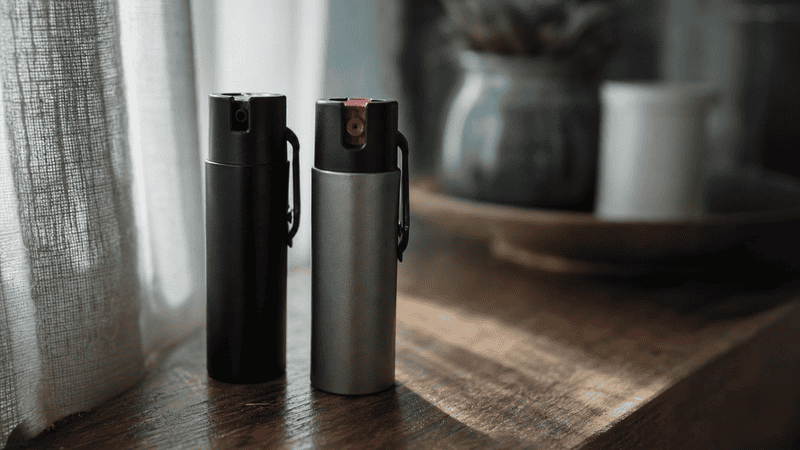
Pepper gel is the better choice for most indoor situations and confined spaces because it doesn’t atomize into the air the way traditional pepper spray does, which means less blowback risk and reduced chance of affecting bystanders. Pepper spray, however, throws a wider disbursement pattern and may reach a threat faster at longer ranges. Which one is actually better depends entirely on where you plan to carry it and how you might use it.
That answer sounds simple. It isn’t. I’ve had customers come to me convinced they knew the difference — and most of them had one piece of the picture, not the whole thing. The gap between what people think they know about pepper spray and pepper gel and what’s actually happening when those formulas leave the canister is wider than most people expect. Let’s close that gap.
What is the real difference between pepper spray and pepper gel?
Both products are built around the same active ingredient — oleoresin capsicum, or OC. That’s the concentrated extract from hot peppers that causes the burning, tearing, and temporary respiratory distress that makes pepper-based defense tools effective. The active ingredient isn’t the mystery. The delivery method is.
Traditional pepper spray is a liquid suspended in a fine mist or stream. When you press the actuator, it releases a fast-moving cloud that expands as it travels. That expansion is part of what makes it effective — a wide disbursement pattern doesn’t require pinpoint aim when your hands are shaking and adrenaline is running. But that same expansion is also why pepper spray in a hallway, a car, or a classroom can become a problem. The particles stay airborne. They drift. They come back.
Pepper gel uses a thick, gel-based carrier — think the consistency of hair gel or a thick lotion. The formula sticks where it lands. It doesn’t atomize. It doesn’t float. It hits a surface, or a face, and it stays there. That one change — carrier fluid to gel — produces a product that behaves in ways most buyers don’t fully anticipate until they read closely or talk to someone who’s actually thought it through.
Brands like Mace and Wildfire make formulas in both configurations. The canister can look nearly identical from the outside. What’s inside is doing something different.
When does pepper gel have an advantage over pepper spray?
Indoors. That’s the short answer, and it matters more than most people realize. If you keep a canister in your bedroom nightstand, your apartment by the door, or your office desk, pepper gel is the formula worth considering. The gel stays where it lands. If you deploy it in a confined space and there’s any chance you’re still in that space — still in the hallway, still near the car door — you’re not breathing in your own defense.
Gel also has a range advantage that surprises people. Because the formula is denser, it can be propelled in a tighter, more accurate stream that carries farther than a fine mist. Some gel formulas reach 18 feet or more. That matters in a parking garage, a stairwell, or any situation where you want distance between yourself and a threat before you engage.
There’s another variable worth knowing: a subject who gets hit with gel and instinctively tries to wipe it off their face actually spreads and intensifies the burn. That’s not a sales line. That’s how the formula works. The natural reflex works against them, not you.
For customers who want something to keep at home or in a vehicle, I usually point them toward gel first and let them decide. Our pepper spray options for vehicles include gel formulas specifically because of the enclosed-space concern. A car is a small box. You’re inside it too.
When is traditional pepper spray the better option?
Outdoors. Wide open spaces. Situations where accuracy under pressure is harder and you need the formula to do some of the work for you. That’s where traditional pepper spray earns its place.
A cone or fog pattern can cover a wider area with a single press. If you’re on a trail, in a parking lot, or in any environment where you have natural ventilation and need to stop a threat that’s moving quickly, that wide disbursement pattern may be exactly what you need. You’re not trying to paint a target. You’re creating a barrier of OC between yourself and danger.
Traditional spray also tends to deploy faster at close range. The mist expands immediately and doesn’t require the same directional accuracy that a gel stream demands. For someone who has never practiced with a canister and is relying on instinct in a worst-case moment, that matters.
People who spend time outdoors — hikers, campers, trail runners — tend to find traditional spray or stream formulas more useful. If you’re in that group, take a look at the pepper spray options we carry for hiking and camping. Outdoor use changes the whole calculation. Blowback is less of a concern when the wind can carry it away from you — though wind direction is always a variable worth watching.
Does pepper gel have any disadvantages worth knowing about?
Yes, and I’d rather tell you now than have you find out when it counts.
Gel requires more accuracy. Because it fires in a tighter stream, you need to land it. A wide mist can be deployed in a general direction and still make contact. Gel rewards practice and penalizes panic. If you’ve never drawn your canister and pressed the actuator, gel is less forgiving at close quarters than a stream or cone spray in the hands of someone who hasn’t trained with it.
Gel also tends to cost slightly more than comparable liquid formulas, and it’s not as universally available at every retail outlet. That’s a practical concern if you’re traveling and need to replace a canister quickly. Not a dealbreaker, but worth knowing.
Cold weather affects gel performance differently than it affects liquid spray. In very low temperatures, the viscosity of a gel formula can change. If you’re in a cold climate and storing a canister in your car during winter, test the spray pattern before you rely on it. This applies to any canister in cold conditions, but gel is more sensitive to it.
How do police-grade formulas factor into the spray vs. gel decision?
There’s a version of this question I hear often: “Is police-grade better?” The answer is: it depends on what you mean by better, and it matters less than most people assume when the formula is in gel form.
Police-grade OC formulas typically use higher OC concentrations or specific Scoville ratings that indicate greater heat intensity. Our police-grade pepper spray for civilians covers this in more detail. The formula matters. But it matters inside the delivery method, not instead of it. A high-OC gel still needs to land accurately. A high-OC spray still needs to reach the target. Grade doesn’t substitute for placement.
What I tell people: get a formula with a serious OC concentration in whichever delivery method fits your situation. Don’t get distracted by marketing claims about grade or heat rating alone. Look at the full picture — range, disbursement, OC percentage, and where you’re carrying it.
Which formula is better for elderly users or people with limited mobility?
This is a question with real stakes, and I take it seriously. Older adults and people with limited hand strength or mobility have specific needs that change the calculus.
For most seniors, I lean toward gel with a finger-grip or ergonomic actuator. Why gel? Because many seniors live in homes, apartments, or assisted living environments — enclosed spaces where blowback from a mist formula could be a genuine problem. Gel keeps the formula where it lands.
That said, the actuator design matters as much as the formula. Stiff actuators that require significant force to press are a real barrier for anyone with arthritis or reduced grip strength. Our pepper spray options for elderly defense focuses specifically on this combination — effective formulas in designs that work with limited hand strength, not against it.
Ergonomics aren’t optional. The best formula in the world is useless if the person carrying it can’t reliably deploy it under pressure.
Frequently Asked Questions About Pepper Spray vs. Pepper Gel
Is pepper gel stronger than pepper spray?
Not inherently. Strength comes from the OC concentration and formula quality, not the carrier. Pepper gel and pepper spray can both be made with high-grade OC formulas. The gel carrier changes how and where the formula is delivered, not how intense it is. A high-OC gel and a high-OC spray can cause the same level of effect — they just get there differently.
Can pepper gel blow back into your face the way spray can?
Blowback risk with pepper gel is significantly lower than with traditional spray. Because the gel doesn’t atomize into airborne particles, wind and air movement affect it much less. It fires in a stream and sticks where it lands. It’s still possible for environmental factors to affect any aerosol product, but gel is meaningfully safer in enclosed spaces and windy outdoor conditions than a mist formula.
How far does pepper gel reach compared to pepper spray?
Many pepper gel formulas reach 15 to 18 feet due to the density of the carrier allowing a tighter, more sustained stream. Traditional stream pepper spray typically covers 8 to 12 feet, while cone or fog patterns trade range for coverage width. Gel’s range advantage makes it a serious consideration for anyone who wants distance before engagement.
Is pepper spray or pepper gel better for carrying in a purse or on a keychain?
Both come in compact carry formats. The choice between spray and gel still comes down to where you’ll use it, not the canister size. A keychain-sized gel is still safer in a car or elevator than the equivalent mist formula. A keychain spray may be better on a walking trail. Choose the formula for the environment first, then find the size that fits your carry preference.
Does pepper gel work the same as pepper spray on an attacker?
Yes — when it makes contact. The OC formula causes the same response: intense burning of the eyes, skin, and mucous membranes, along with temporary respiratory distress and disorientation. The gel carrier adds one variable: the natural reflex to wipe the face actually spreads and intensifies the burn, which can increase effectiveness on contact. The formula needs to land accurately to do its job.
Can I use pepper gel indoors?
Pepper gel is specifically well-suited to indoor use. Because the formula doesn’t atomize into the air, it won’t drift, settle on surfaces throughout a room, or affect others in the space the way a mist formula can. This makes it a better choice for home defense, office carry, hotel rooms, and any enclosed environment. It’s still a serious chemical agent — deploy it deliberately and exit the area quickly after use.
Do I need to check local laws before buying pepper spray or pepper gel?
Yes, always. Laws around OC products vary significantly by state, city, and sometimes by formula strength or canister size. Some states restrict who can purchase them, what concentration is legal, or how they can be carried. Always check your state and local laws before purchasing or carrying any pepper-based defense product. We sell to adults who take that responsibility seriously.
Does pepper gel work differently in cold weather?
Cold temperatures affect pepper gel more than traditional liquid spray because the gel’s viscosity increases in the cold, which can change the spray pattern and reduce distance. If you’re storing a gel canister in a vehicle during winter or carrying in a cold climate, test the canister periodically in a safe, open area. Any canister left in extreme heat or cold should be tested and replaced if performance changes.
Most people come to this question thinking there’s a clear winner — one formula that beats the other across every situation. There isn’t. What there is, is a right tool for a specific environment, a specific person, and a specific set of realistic scenarios. That’s always been the heart of how I think about this.
If you’re still working through which option fits your life, browse the pepper spray selection at HerGuarded and look at the product details — range, formula type, OC concentration, and carry format are all there. You might also find it useful to read about how pepper-based formulas compare in entirely different use cases, like our post on whether bear spray works on mountain lions — it gets into OC delivery in ways that sharpen your thinking on any OC product. Be aware. Be prepared. Be confident in what you’re carrying and why.